
Introduction
The Indus Valley Civilization (IVC), also known as the Harappan Civilization, stands as one of the most remarkable achievements of the ancient world. Flourishing around 3300 BCE to 1300 BCE, it spread across a vast region of present-day Pakistan, northwestern India, and parts of Afghanistan. Alongside Mesopotamia and Egypt, it is recognized as one of the world’s earliest cradles of civilization. Unlike many ancient societies that were heavily centralized around kings and monumental temples, the Indus Valley displayed a unique urban culture marked by planned cities, advanced drainage systems, standardized weights and measures, and a still undeciphered script.
This article explores the origins, society, economy, religion, art, trade, and legacy of the Indus Valley Civilization while also discussing the reasons behind its mysterious decline.
Origins and Discovery of the Civilization
The existence of this ancient civilization remained hidden for millennia until the 1920s, when excavations at Harappa (Punjab, Pakistan) and Mohenjo-Daro (Sindh, Pakistan) brought to light an advanced culture buried beneath the soil. Archaeologists Sir John Marshall and Dayaram Sahni were among the first to identify the urban ruins as part of an ancient civilization. Soon after, numerous sites were discovered across Gujarat, Rajasthan, Haryana, and Baluchistan, proving that the civilization covered nearly 1.3 million square kilometers, making it one of the largest in the ancient world.
Early Farming Communities
The roots of the IVC can be traced back to Mehrgarh (7000 BCE) in Baluchistan, one of the earliest known farming settlements in South Asia. Here, people cultivated wheat and barley, domesticated cattle, and lived in mud-brick houses. These Neolithic traditions slowly evolved into the urban sophistication of the Harappan world.
Urban Planning and Architecture
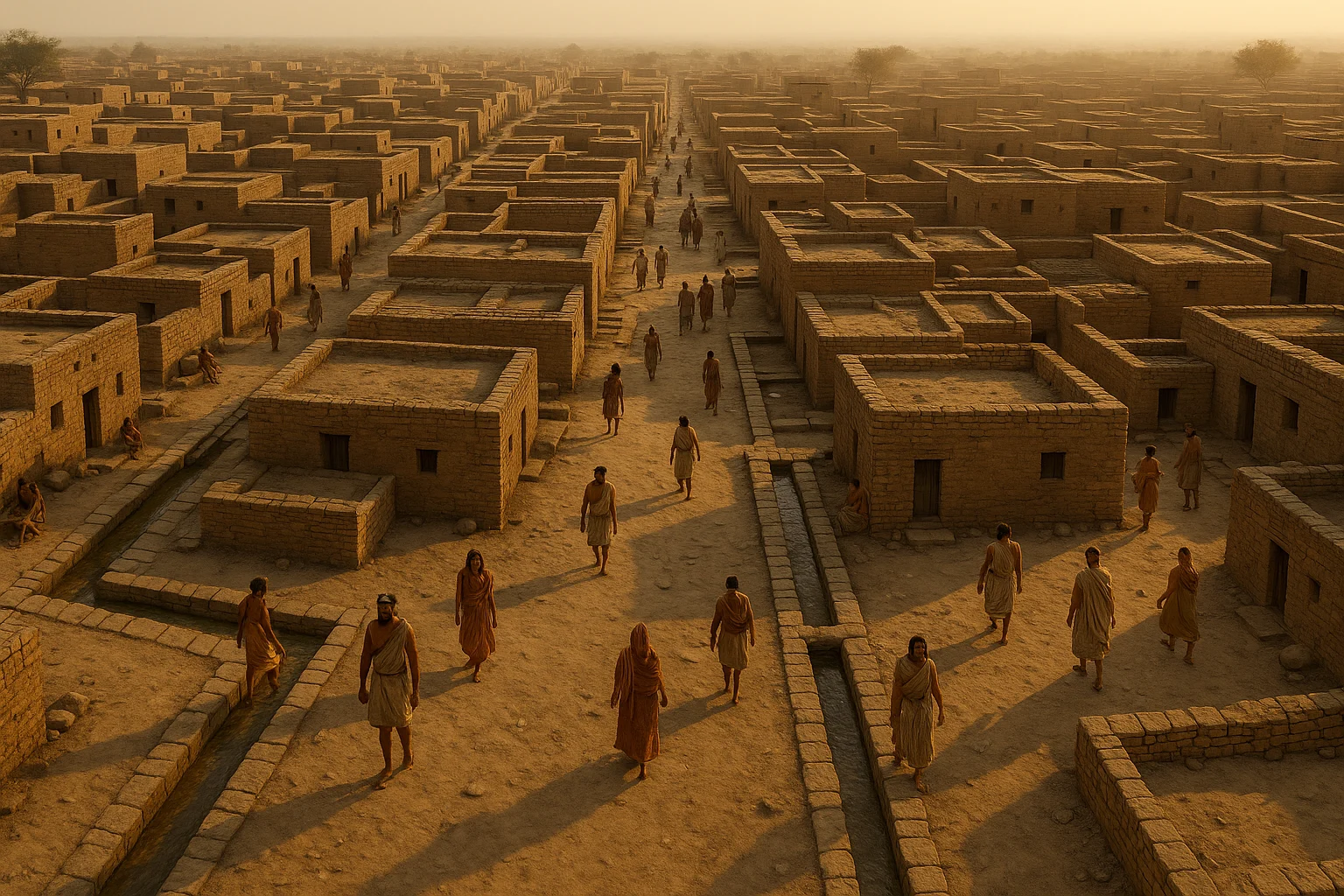
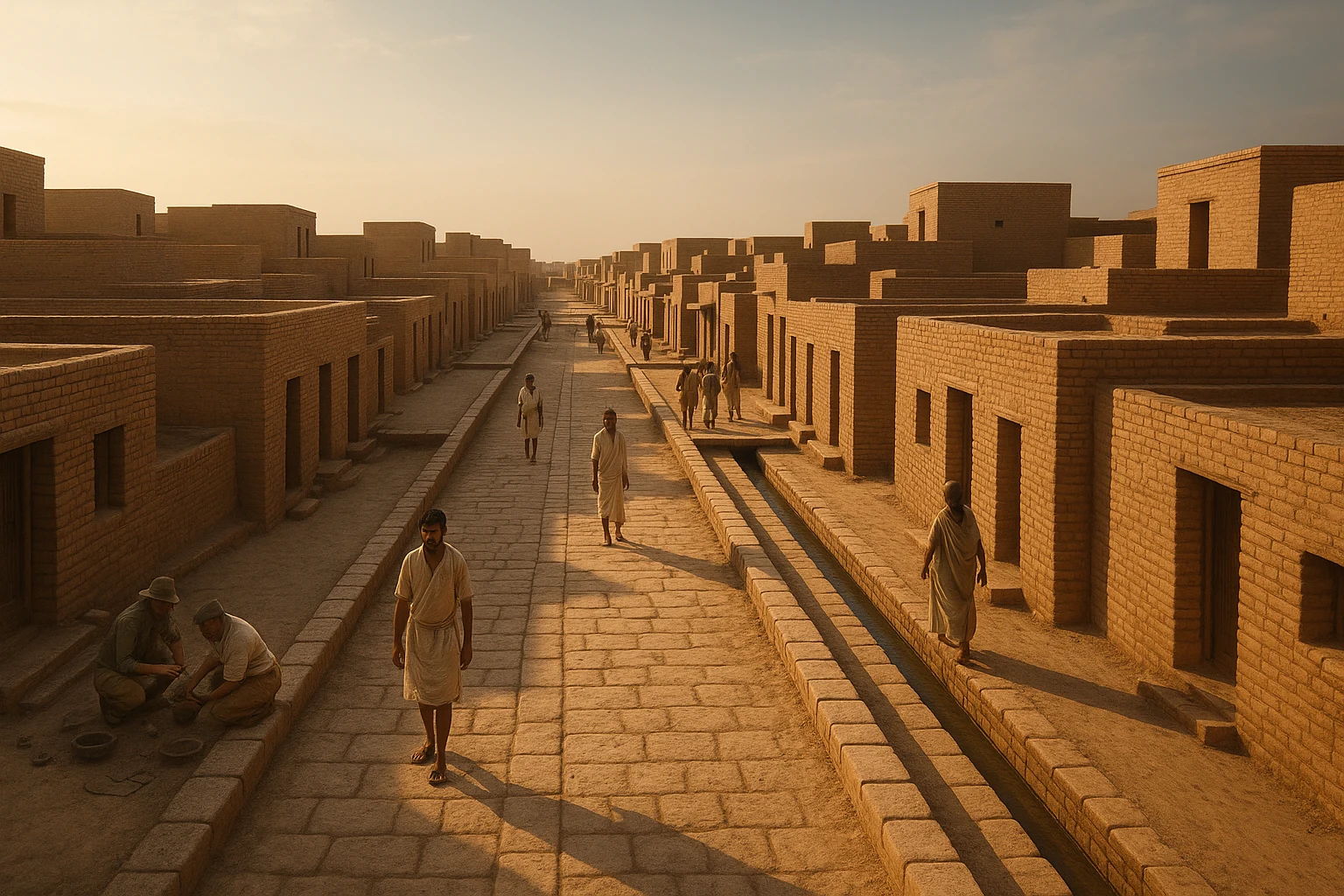
One of the most striking features of the Indus Valley Civilization was its urban planning. Unlike the organic, unplanned growth of many ancient cities, Harappan towns were carefully designed.





































Grid-Patterned Streets
Streets were laid out in a grid pattern, intersecting at right angles, dividing the city into rectangular blocks. This suggests the presence of strong civic authorities who understood geometry and town planning.
Advanced Drainage Systems
Perhaps the most extraordinary achievement was the drainage system. Every house was connected to covered drains running along the main streets. These brick-lined drains had inspection holes for cleaning, demonstrating a concern for public hygiene unmatched until Roman times.
Great Bath of Mohenjo-Daro
The Great Bath, a massive public water tank, is one of the most iconic structures. With waterproof brick lining and a sophisticated water inflow and outflow system, it suggests ritual bathing and community gatherings.
Standardized Bricks and Building Materials
Harappans used standardized baked bricks of ratio 1:2:4 for construction, indicating uniformity across cities separated by hundreds of kilometers.
Society and Daily Life
Unlike Egypt and Mesopotamia, the IVC shows no evidence of kings, palaces, or giant temples. Instead, it seems to have been governed through a collective civic authority or local councils.

Social Organization
- Houses ranged from large multi-roomed homes to modest single-room dwellings, reflecting a degree of social differentiation but not extreme inequality.
- There are no grand royal tombs or extravagant monuments, suggesting a relatively egalitarian society.
Family and Occupations
Most families were engaged in farming, craftwork, or trade. Evidence of bead-making workshops, pottery kilns, and metalworking suggests specialized artisans. Women likely played a central role in household and agricultural activities.
Economy and Trade
Agriculture
The fertile floodplains of the Indus River supported crops such as wheat, barley, peas, sesame, and cotton—the earliest evidence of cotton cultivation in the world. Irrigation was simple but effective, relying on seasonal flooding.
Crafts and Industry
Harappans excelled in pottery, bead-making, shell carving, and metallurgy. Copper, bronze, gold, and silver artifacts have been found, reflecting both utility and artistry.
Trade Networks
The IVC had extensive trade networks:
- Within India: Trade with Gujarat’s coastal towns (Lothal, Dholavira) brought shell, semi-precious stones, and fish.
- International: Harappan seals and goods have been found in Mesopotamia, Oman, and Bahrain. Items like lapis lazuli, carnelian beads, and cotton textiles were exchanged for silver, tin, and wool.
The port city of Lothal in Gujarat contained a sophisticated dockyard, highlighting maritime trade.

Religion and Beliefs
The Harappan religion remains mysterious, as their script has not yet been deciphered. Still, archaeological findings provide clues:
- Mother Goddess figurines suggest fertility worship.
- Seals depicting animals hint at animism or symbolic significance.
- A famous seal depicts a horned figure in a yogic posture, often identified as a proto-Shiva or “Pashupati.”
- Fire altars discovered at Kalibangan indicate ritual practices.
Unlike Mesopotamia or Egypt, there are no grand temples—suggesting religion may have been localized and community-based.
Language and Script
The Indus script, found on seals, pottery, and tablets, consists of around 400 signs. Despite decades of study, it remains undeciphered. Scholars debate whether it represents a full language or symbolic system. If deciphered, it could unlock vast knowledge about Harappan politics, laws, and culture.

Art and Craftsmanship
Harappan art reflected both utility and creativity:
- Pottery: Red ware decorated with black geometric patterns.
- Seals: Steatite seals engraved with animals like bulls, elephants, and unicorns.
- Beads and Jewelry: Made from carnelian, lapis lazuli, and gold, indicating aesthetic refinement.
- Terracotta Figurines: Representing humans, animals, and toys like carts and whistles, reflecting daily life and recreation.
Decline of the Civilization
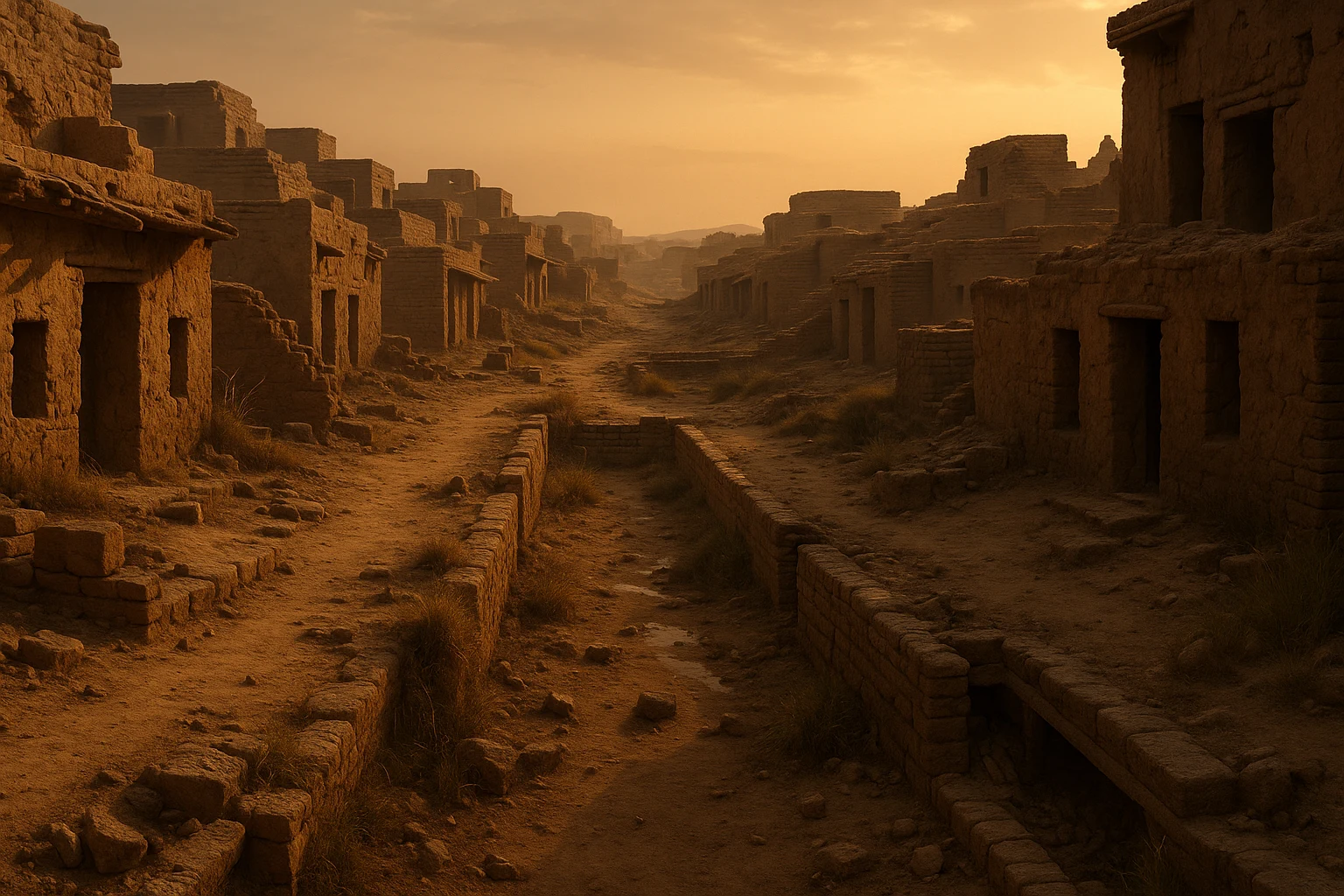
The decline of the Indus Valley Civilization around 1900 BCE remains one of history’s great mysteries. Several theories exist:
- Environmental Changes: Shifting river courses, including the drying of the Saraswati River and flooding of the Indus.
- Decline in Trade: Collapse of Mesopotamian trade links weakened the economy.
- Overuse of Resources: Deforestation and soil degradation reduced agricultural productivity.
- Invasions or Migrations: Some scholars once believed Aryan invasions played a role, but evidence now points more to gradual decline than sudden conquest.
By 1300 BCE, most cities were abandoned, although rural settlements continued in smaller forms.
Legacy of the Indus Valley Civilization
Despite its decline, the IVC left a lasting legacy:
- Urban Planning Models: Later Indian cities inherited concepts of drainage and grid planning.
- Cultural Continuity: Religious symbols like the Mother Goddess and proto-Shiva influenced later Hindu traditions.
- Agriculture and Crafts: Techniques of cotton cultivation, pottery styles, and metallurgy continued.
- Historical Importance: The civilization challenged earlier notions that India’s history began only with the Vedic age.
Today, the IVC is celebrated as a symbol of India’s deep cultural roots and intellectual achievements.
Conclusion
The Indus Valley Civilization was a sophisticated, urban, and peaceful culture that flourished thousands of years ago. With its well-planned cities, advanced sanitation systems, thriving trade, and artistic expression, it stands as a beacon of early human ingenuity. The mystery of its script and the puzzle of its decline continue to fascinate scholars and enthusiasts alike. As excavations and research progress, new insights into this ancient civilization will further enrich our understanding of human history.
Receive Stories and Articles in your Inbox!
We won’t send any promotional or spam emails.
